An Investigative Series · 2026

The AIBubble

Doomsday

How the AI industry is writing a familiar tragedy and why the reckoning may be closer than anyone wants to admit.

Chapter 1
The Illusion of Cheap AI : Subscriptions vs. Hardware
Chapter 2
The Burn Rate : How OpenAI & Anthropic Are Bleeding Cash
Chapter 3
Burry's Warning & the GPU Depreciation Clock
Conclusion
A Familiar Story : Three Possible Outcomes for the AI Bubble

This is not investment advice. It’s just my view on how AI will play out in the long run. I’m an ordinary SDE who likes to build stuff and share views like this.

Ch. 1 : The Illusion of Cheap AI
Chapter One

The Illusion of Cheap AI

Subscriptions vs. Hardware : What Are You Really Paying For?

There is a pattern in the history of technology that repeats itself with remarkable fidelity. First comes genuine innovation. Then comes irrational exuberance. Then the reckoning. We lived through it with the dot-com boom. With the housing market. And right now, quietly but unmistakably, we may be watching the earliest tremors of the next great bubble, the AI bubble.

I am paying $200/month for Claude Code. That already felt great for someone working as a software engineer and building side projects before AI. What I discovered when I dug deeper into the numbers made me rethink the entire economics of this industry.

The Subscription Math

Let's start with a simple, honest question: is the AI subscription you are paying for actually a good deal? On the surface, $200 a month for access to a state-of-the-art language model sounds almost too good to be true. As it turns out, it probably is.

A recent analysis broke down the true cost of running AI inference by comparing three scenarios: subscription, cloud rental, and owning hardware outright.

The Shared Hardware Thought Experiment

Imagine pooling resources with four friends. Collectively you are spending $57,600 over six years on subscriptions. A shared H100 card, factoring in electricity and cooling, has a total cost of ownership of roughly $33,700, nearly $24,000 less for the same five people.

But here is where it gets complicated. A single H100 cannot run the models you actually want to use. Even an efficient frontier model at full precision requires a minimum of 14 H100 cards. The NVIDIA DGX H100 system runs $285,000-$300,000. Add six years of operating costs and you're looking at ~$400,000 total.

To break even at current subscription prices, you would need approximately 28 people sharing the system, each working with severely constrained memory. The concurrency problem alone makes this unworkable for most real-world use cases.

What This Tells Us

The companies providing your AI subscriptions are subsidizing your usage at a staggering scale. The inference providers managing energy, cooling, networking, and hardware at scale are doing something genuinely impressive. They are also, as we will see in the next chapter, doing it at a loss.

Inference providers are not running charities. They are running a land grab, acquiring users at below-cost prices in the hope that they can eventually raise prices, achieve profitability through scale, or find an exit before the money runs out.
Questions This Chapter Forces Us to Ask
How are Anthropic and OpenAI actually sustaining themselves and how are they making money, or are they?
Can these pricing levels be sustained long-term? Based on the hardware math above, the answer looks like no.
Would you pay $24000/year, 10x today's price, to keep using Claude Sonnet or GPT-5 for your projects?
Is hiring skilled people actually cheaper than AI at that pricing, especially once prices normalize?
Are open-source models already a better, cheaper alternative to closed frontier models?
Ch. 2 : The Burn Rate
Chapter Two

The Burn Rate

How OpenAI and Anthropic Are Spending Their Way to the Edge

In the world of Silicon Valley startups, burning cash to acquire market share is a time-honored tradition. You lose money aggressively in the early years, build a dominant position, then flip the switch to profitability once you own the market. Amazon did it with retail. Uber did it with ride-sharing. Spend now, harvest later.

The question with AI companies is whether "later" will ever arrive and whether the math of getting there is survivable.

OpenAI: Revenue vs. Reality

OpenAI has made significant progress on revenue. Reports suggest annual revenues crossing $4 billion and growing rapidly. That sounds impressive until you look at the other side of the ledger. Training runs for frontier models cost hundreds of millions of dollars each. Infrastructure costs are astronomical. And the competitive pressure to keep releasing more capable models means those costs only go up.

Then there is the Nvidia problem. OpenAI has entered into significant agreements with Nvidia to secure GPU supply, hardware that costs tens of billions to acquire at the needed scale. The company is essentially betting its future on a hardware arms race it cannot afford to lose and may not be able to fund.

Anthropic: Enterprise-First, But Still Burning

Anthropic has made a strategic choice to focus on enterprise customers, with larger budgets, stickier relationships, premium pricing. With significant Amazon backing, the approach has traction. But Anthropic is still burning cash at scale. And there is a darker implication to the enterprise model that deserves honest examination:

If Anthropic's pitch to enterprises is that 2-4 people using Claude can do the work of 10, and companies adopt that pitch, then 6 people lose their jobs. The savings those companies realize flow to Anthropic as revenue. The AI industry is, in a very real sense, monetizing unemployment.

Cursor and the Developer Tool Layer

Cursor, the AI-powered code editor, is a useful microcosm. At $200/year for individuals, it's already asking users to accept a meaningful ongoing cost. Yet Cursor operates at thin margins, paying per-token costs to model providers while trying to build a sustainable business on top.

The developer tool layer is caught in a squeeze: it cannot charge too much or users walk away, but it cannot charge too little because underlying compute costs are enormous. The entire stack is being propped up by investor capital running on faith rather than fundamentals.

The Nvidia Deal and What It Reveals

OpenAI's GPU agreements with Nvidia reveal something important: the largest AI company in the world does not have the cash flow to build out its own data centers from operations. It is financing loss-making infrastructure through equity raises and strategic partnerships.

OpenAI raises capital → buys Nvidia chips → runs chips at below-cost pricing to acquire users → raises more capital to buy more chips. Meanwhile, Nvidia, the only party undeniably profitable, collects payment regardless of whether the AI services built on its hardware ever achieve sustainable unit economics. This is a transfer of wealth from venture capital and retail investors to Nvidia, dressed up in the language of technological transformation.
The Nvidia Deal - OpenAI GPU agreements
The circular capital flow: OpenAI ↔ Nvidia, who actually wins?
CompanyStrategyBurn RiskPath to Profit
OpenAIConsumer + API + EnterpriseVery HighAds + Scale
AnthropicEnterprise-FirstHighEnterprise margin
CursorDev tooling on APIsHighUnclear
Ch. 3 : Burry's Warning & the GPU Clock
Chapter Three

Burry's Warning and the GPU Clock

What the Man Who Predicted 2008 Is Saying About AI

Michael Burry became famous for seeing what others refused to see. He noticed that the mortgage-backed securities underpinning the housing market were built on loans that would never be repaid. Everyone insisted this time was different. He shorted the market and made a fortune when reality reasserted itself.

Burry has been watching the AI buildout with similar skepticism. His posts on X have pointed to a simple, devastating arithmetic problem at the heart of the AI infrastructure boom, GPU depreciation.

𝕏
Michael Burry @michaeljburry
Short Nvidia

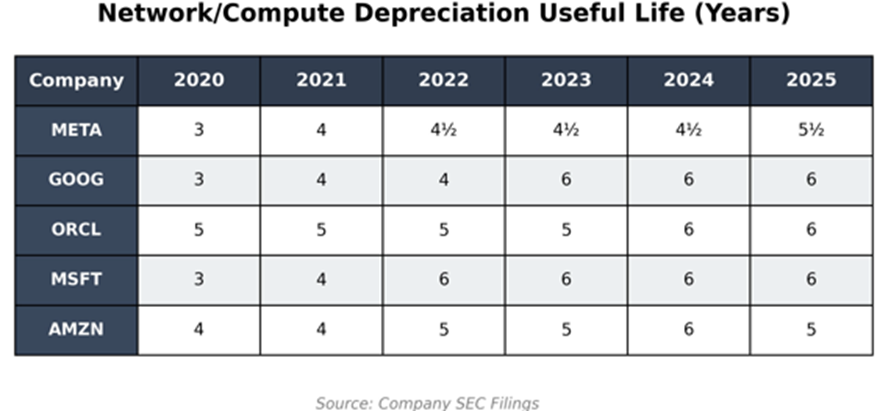
"Understating depreciation by extending useful life of assets artificially boosts earnings, one of the more common frauds of the modern era. Massively ramping capex through purchase of Nvidia chips/servers on a 2-3 year product cycle should not result in the extension of useful lives of compute equipment. Yet this is exactly what all the hyperscalers have done. By my estimates they will understate depreciation by $176 billion 2026-2028. By 2028, ORCL will overstate earnings 26.9%, META by 20.8%, etc. But it gets worse."

The 4-6 Year Problem

Every major technology company operates on an asset depreciation schedule for data center hardware. For GPU clusters, that window is typically four to six years. After that, the hardware is obsolete, too energy-inefficient, or physically worn out.

The $30,000 H100 card analyzed in Chapter 1 has a useful economic life of perhaps five years. The DGX H100 system, ~$400,000 TCO, will need to be replaced within that same window. Not upgraded. Replaced. With whatever next-generation hardware requires.

This means the AI infrastructure buildout is not a one-time capital expenditure. It is a perpetual treadmill. Every five years, on average, the entire foundation must be rebuilt from scratch.

Michael Burry GPU depreciation data chart
Burry's data: hyperscaler GPU depreciation understated by an estimated $176B from 2026-2028

The DeepSeek Scenario

In early 2025, DeepSeek released a model performing comparably to leading closed-source models at a fraction of the training cost. Nvidia's stock dropped sharply. The entire premise that frontier capability required frontier-level spending was suddenly in question.

Let's say, DeepSeek 2.0, arrives tomorrow in the next two to three years at same SWE bechmark scores and similar to lower inference cost, could crash market by 30 to 50 percent overnight.

The open-source threat is not speculative. It is the default trajectory of software development. The question is not whether cheaper, open source alternatives will arrive, it is whether the closed-source labs will still be standing when they do.

The Government Wildcard

There is one force capable of delaying this reckoning significantly: government money. Just as the housing bubble was extended by government-backed mortgage programs, the AI bubble is being inflated by sovereign capital. The US, EU, China, and Gulf states are all treating AI infrastructure as a matter of national strategic importance.

This government support delays the day of reckoning. The delay typically makes the eventual correction more severe. The larger the bubble grows, the more painful the pop.

What Could Slow the Burn

Advertising revenue. OpenAI's move toward ad-supported models could reduce reliance on subscription fees, slowing the burn rate, not stopping it.

Enterprise margins. Anthropic's enterprise focus provides higher per-seat revenue. If those margins cross-subsidize consumer pricing, the path to sustainability narrows but doesn't disappear.

Hardware efficiency. Each GPU generation delivers more compute per watt. If efficiency improvements outpace model size requirements, the economics gradually improve.

Open models. Paradoxically, open-source models could reduce the compute burden, cheaper inference means slower burn. But it also collapses the premium closed-source labs depend on.

These are mitigating factors, not solutions. They slow the burn rate. They do not make the business model profitable.

Conclusion : A Familiar Story
Conclusion

A Familiar Story

The dot-com bubble didn't destroy the internet. But it destroyed a generation of companies that forgot fundamentals.

The dot-com bubble did not destroy the internet. Amazon survived. Google thrived. The companies that had genuine value propositions and the patience to outlast the correction became the defining companies of the next generation.

The AI bubble, when it comes and the evidence suggests it is building, will not destroy artificial intelligence either. The technology is genuinely transformative. LLMs, multimodal models, and AI agents will reshape work, creativity, and daily life in ways we are only beginning to understand.

But the financial architecture currently surrounding that technology, the below-cost subscriptions, the debt-financed hardware buildouts, the perpetual depreciation treadmill, the government-inflated valuations, is not sustainable.

At some point, pricing must reflect reality. At some point, the hardware bills come due. At some point, an open-source model good enough for most use cases arrives and collapses the premium that closed-source labs depend on.

The question for users, developers, and businesses is not whether to use AI. The question is how to use it without betting your workflow, your business model, or your career on a pricing structure that may look very different in three to five years.

And the question for investors, policy makers, and anyone watching the capital flows is more pointed: we have seen this movie before. The ending is not always the same, but the middle act, the irrational exuberance, the subsidized growth, the delayed reckoning, tends to follow a recognizable script.

The infrastructure is real. The technology works. The business model is the question. And right now, nobody in the industry has a clean answer to it.

You might ask, "What a Post-Bubble AI Landscape Looks Like and Who Survives? and the answer is, IDK 😜."